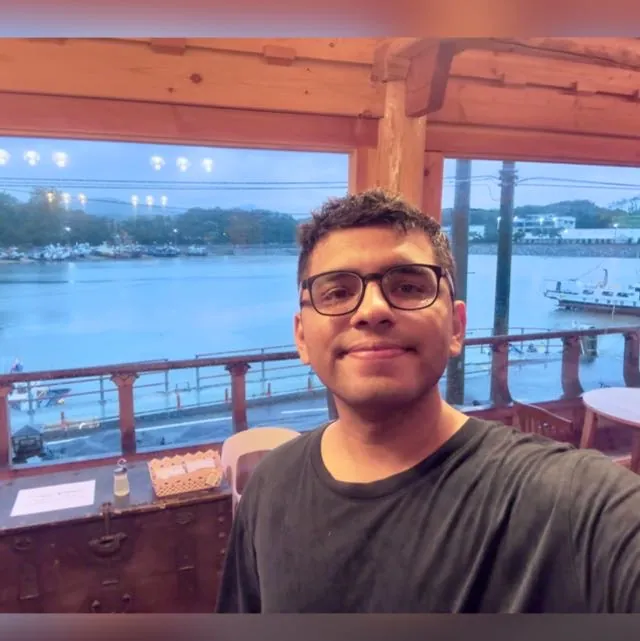
Ph.D. researcher, MLVC Lab, Kyung Hee University

Ali Haider

From circuits and embedded systems to vision intelligence and data.

I am a Ph.D. researcher in Artificial Intelligence at Kyung Hee University Global Campus, in the Machine Learning and Visual Computing (MLVC) Lab under Professor Sung Ho Bae. I currently work on vision-language navigation for drones, diffusion models for images and language, and MRI reconstruction. My earlier work covers implicit neural representations and image restoration.

I am from Pakistan, where I earned a B.Sc. in Electronics Engineering at UET Taxila and worked as a Research Assistant at CISS-Global, ITU Lahore, under Dr. Qasim Mehmood. I have published at AAAI and in Infrared Physics & Technology, with collaborations at Adobe Research and Télécom Paris. Outside research I enjoy reading, traveling and building things.

Portrait of Ali Haider
  • Vision-Language Navigation
  • Embodied & Aerial Agents
  • Multimodal Reasoning
  • Diffusion Language Models
  • Diffusion Models
  • Implicit Neural Representations
  • MRI Reconstruction
  • Efficient VLMs
01 /

News

02 /

Learning these days

course · Stanford CS 329Ain progress

Self-Improving AI Agents

Working through Stanford's CS 329A, taught by Azalia Mirhoseini and Aakanksha Chowdhery, with James Le's write-up of its nine lectures as a guide. The main idea: an agent gets better by generating many candidate answers, checking them, and learning from the ones that pass.

  1. sample
  2. verify
  3. learn

round 1success 0%

Illustration: the agent tries several answers, a checker keeps the good ones, and it learns from those.
The nine lectures
  1. What makes an agent self-improving; inference-time scaling
  2. Test-time compute, repeated sampling and search
  3. Verifiers: outcome and process reward models
  4. Learning from tool and environment feedback; self-critique
  5. Planning, tree search and parallel execution
  6. Train-time scaling, reinforcement learning and GRPO
  7. Large-scale search and deep-research agents
  8. Evaluating agents on long-horizon tasks
  9. Open problems: verifiers for hard-to-verify domains, self-generated curricula, intelligence per watt
03 /

Side projects

Code on GitHub.

agent skill · writing

paper-review-lab

An agent skill for evidence-first manuscript writing in machine learning, computer vision and health research. Independent reviewers, including a blind reader, test the argument; one editor applies the supported changes; offline checks catch changed facts, citations and terminology. Scoring on 24 anchored criteria is optional.

  • Python
  • agent skill
  • 10,000 citation records
desktop apppreview

orbit-remote

Remote desktop for your own Windows, macOS and Linux computers over your private Tailscale network. There is no Orbit server or account: devices pair with a single-use invitation and a pinned certificate, traffic is encrypted twice (WireGuard and mutual TLS 1.3), and the host grants view, control, clipboard, files and power separately. A Windows computer shares its screen as hardware H.264 video (59 fps measured at 2560×1440), and Windows and an Apple-silicon Mac can view each other.

  • C#
  • Tailscale
  • mutual TLS
  • Windows · macOS preview
inference engine

nibblepi

Qwen3.5 on a Raspberry Pi 4 at 20 tokens/s: a from-scratch C engine with NEON kernels, its own 4-bit weight format, speculative decoding that matches plain greedy output token for token, long context and an OpenAI-compatible server.

  • C11 + NEON
  • Raspberry Pi 4
  • Qwen3.5 0.8B · 2B
  • Apache-2.0
inference engine · macOSexperimental

nibblemac

nibblepi's engine brought to Apple Silicon: native C and Objective-C with Metal, packed 4-bit weights kept in unified memory. On an M2 Pro the CPU path (SDOT) decodes Qwen3.5-0.8B at 210 tokens/s with unchanged perplexity; the Metal path is opt-in, because so far it is slower (119 tokens/s).

  • C · Objective-C
  • Metal
  • Apple Silicon
  • Apache-2.0
port

cerno-pi

Runs Apertix's Cerno 4B decision models on a Raspberry Pi 4 with the nibblepi engine: a state and typed questions in, calibrated probabilities per option out, in one forward pass. With the model loaded, the first answer takes 12.3 s. An independent port; Cerno is Apertix's work.

  • Raspberry Pi 4
  • Apache-2.0
hardware simulation

cerno-rtl

Runs the complete 32-layer Cerno 4B text decoder on the openTPU accelerator in Verilator, from prompt tokens to a typed decision. Every batch matched an independent model of the instruction set bit for bit, and the answer probability came out at 0.976 against llama.cpp's 0.977. Cerno is Apertix's work and openTPU is FeSens's; this is the harness around them.

  • Verilator
  • openTPU
  • RTL
  • Apache-2.0
collaboration · equal contributionactive

fingerprint-from-image

Fingerprint recognition from ordinary phone photos and scans: learned hand landmarks find the fingertips, a metric-learning network turns each one into a compact embedding, and matching needs a quorum of fingers. Exports to ONNX Runtime and LiteRT for server, mobile and edge. Built with @m-mutti; I am an active contributor with an equal share of the work.

  • PyTorch
  • ONNX · LiteRT
  • biometrics
tool

gpu-pulse

Live GPU, CPU and memory dashboards in VS Code (also over Remote-SSH) or any terminal: usage history, true GPU utilization from SM, Tensor Core and DRAM activity, and a bottleneck diagnosis with suggested fixes. Runs on Windows, Linux and, since October 2026, Apple Silicon Macs (Metal).

  • VS Code extension
  • Python terminal app
  • NVIDIA · Apple Metal
  • MIT
language

urdupy

اردو پائی — an Urdu-first Python frontend. You write code with Urdu keywords, names and file names, and it runs on real CPython with any pip package.

  • CPython 3.12+
  • PyTorch · NumPy · OpenCV
course

jev-learning-course

A self-paced notebook course on Jev: typed AI decisions, calibration and related models. It has eleven notebooks and four assignments, and runs on CPU only.

  • Jupyter
  • calibration
  • decision models
course

language-diffusion-models

A from-scratch course on diffusion models for text. Runnable notebooks tie every equation to its paper: MDLM, LLaDA, D3PM, Diffusion-LM and SEDD.

  • PyTorch
  • diffusion LMs
curated list

awesome-language-diffusion

356 verified papers, models and resources on language diffusion, from foundations and discrete-diffusion theory to 7B–100B diffusion LLMs, reasoning, inference and evaluation.

  • awesome list
  • dLLMs
04 /

Publications

Full list on Google Scholar.

  • SIREN versus I-SIREN on image fitting (+1.69 dB PSNR), 2× super-resolution (+0.73 dB) and denoising (+2.18 dB).

    AAAI 2026

    I-INR: Iterative Implicit Neural Representations

    Ali Haider, Muhammad Salman Ali, Maryam Qamar, Tahir Khalil, Soo Ye Kim, Jihyong Oh, Enzo Tartaglione, Sung-Ho Bae

    AAAI Conference on Artificial Intelligence, 2026 · Singapore

    In collaboration with LTCI, Télécom Paris & Adobe Research

    Trainingminθ⁡𝔼‖fθ(g˜(x)t,x,t)−ℐ(x)‖22g˜(x)t=(1−t)ℐ(x)+t𝒵+εtn

    Refinement stepgˆ(x)t−δ=δtfθ(gˆ(x)t,x,t)+(1−δt)gˆ(x)t

    Cite
    @inproceedings{haider2026iinr,
      title     = {{I-INR}: Iterative Implicit Neural Representations},
      author    = {Haider, Ali and Ali, Muhammad Salman and Qamar, Maryam and Khalil, Tahir and Kim, Soo Ye and Oh, Jihyong and Tartaglione, Enzo and Bae, Sung-Ho},
      booktitle = {Proceedings of the AAAI Conference on Artificial Intelligence},
      volume    = {40},
      number    = {6},
      pages     = {4520--4528},
      year      = {2026},
      doi       = {10.1609/aaai.v40i6.42451},
      eprint    = {2504.17364},
      archivePrefix = {arXiv}
    }
  • DescanDiffusion: a global colour correction of the scanned image, then local refinement with a conditional diffusion model.

    AAAI 2024

    Descanning: From Scanned to the Original Images with a Color Correction Diffusion Model

    Junghun Cha*, Ali Haider*, Seoyun Yang, Hoeyeong Jin, Subin Yang, A. F. M. Shahab Uddin, Jaehyoung Kim, Soo Ye Kim, Sung-Ho Bae

    AAAI, Vol. 38 No. 2, 2024

    In collaboration with Adobe Research

    Colour correctionIck=Isk−μskσsk+εσck+μck

    Diffusion lossL=𝔼‖ϵ−ϵθ(xt,t,Ic,vc)‖

    Cite
    @inproceedings{cha2024descanning,
      title     = {Descanning: From Scanned to the Original Images with a Color Correction Diffusion Model},
      author    = {Cha, Junghun and Haider, Ali and Yang, Seoyun and Jin, Hoeyeong and Yang, Subin and Uddin, A. F. M. Shahab and Kim, Jaehyoung and Kim, Soo Ye and Bae, Sung-Ho},
      booktitle = {Proceedings of the AAAI Conference on Artificial Intelligence},
      volume    = {38},
      number    = {2},
      pages     = {954--963},
      year      = {2024},
      doi       = {10.1609/aaai.v38i2.27855}
    }
  • A fully convolutional regression network turns a thermal frame into a density map; thresholding, contours and centroids give each person's position.

    Journal Infrared Physics & Technology

    Human Detection in Aerial Thermal Imaging using a Fully Convolutional Regression Network

    Ali Haider, Furqan Shaukat, Junaid Mir

    Infrared Physics & Technology 116 (2021) · Impact Factor: 3.4

    Detection pipeline (a sketch, not an equation from the paper)Dˆ=Fθ(I)𝐜k=1|Rk|∑p∈Rkp,Rk⊂{Dˆ>τ}

    Cite
    @article{haider2021fcrn,
      title   = {Human Detection in Aerial Thermal Imaging using a Fully Convolutional Regression Network},
      author  = {Haider, Ali and Shaukat, Furqan and Mir, Junaid},
      journal = {Infrared Physics \& Technology},
      volume  = {116},
      pages   = {103796},
      year    = {2021},
      doi     = {10.1016/j.infrared.2021.103796}
    }
  • Denoising a noisy photo (17.64 dB): the robust loss edges out MSE for both WIRE (29.18 vs 29.14 dB) and SIREN (26.72 vs 26.66 dB).

    KMBE 2024

    Improving Implicit Neural Representations with Robust Loss Function

    Ali Haider, Sung Ho Bae

    Korea Broadcasting Media Engineering Conference, 2024: 998–1001

    Objective (a sketch, not an equation from the paper)1N∑i‖fθ(xi)−yi‖22⟶1N∑iρc(fθ(xi)−yi)c=0.8

    Cite
    @inproceedings{haider2024kmbe,
      title     = {Improving Implicit Neural Representations with Robust Loss Function},
      author    = {Haider, Ali and Bae, Sung Ho},
      booktitle = {Korea Broadcasting Media Engineering Conference},
      pages     = {998--1001},
      year      = {2024}
    }
05 /

Patents

  • Patent Korean Intellectual Property Office

    Apparatus and Method for Image Restoration Based on Machine Learning

    Sung-Ho Bae, Junghun Cha, Ali Haider

    KIPO · No. 10-2024-0169006 · 2024

    With AI Factory (인공지능팩토리)

    Cite
    @misc{bae2024patent,
      title        = {Apparatus and Method for Image Restoration Based on Machine Learning},
      author       = {Bae, Sung-Ho and Cha, Junghun and Haider, Ali},
      year         = {2024},
      howpublished = {Korean Intellectual Property Office (KIPO), No.~10-2024-0169006},
      doi          = {10.8080/1020240169006}
    }
06 /

Projects

Vision-Language Navigation for Drones Ongoing Research

Developing a vision-language navigation system for drones (UAVs): the aerial agent follows natural-language instructions, with lightweight VLMs for spatial and semantic reasoning.

instruction ›

    Illustration: a drone following a written instruction; the dashed box is what it is looking at.
    • MRI Acceleration and Reconstruction Ongoing Research

      In collaboration with AiLive and NYU — diffusion models and multi-modal frameworks for faster, accurate clinical MRI diagnostics.

    • Video Quality Assessment for Streaming Media

      With KEI Media — perceptual video quality benchmarking and no-reference quality assessment metrics for streaming platforms.

    • Microscopic Malaria Detection Research

      Low-cost AI diagnostic system with Lahore General Hospital (CISS-Global) — virtual staining, image enhancement, and low-resource detection.

    • AI-based Sports Card Grading Acquired by Beckett Media

      Algorithm lead at Due Dilly — automated PSA/Beckett-standard grading via large-scale data curation and visual centering networks. Startup acquired by Beckett Media.

    • Track-following Robot (PID) 1st place, AirTech 2017

      PID-controlled line-following robot on ATMEGA328P-PU. 1st place nationally at AirTech 2017.

    • Embedded Vehicular Security System 2nd prize, DICE-IET 2019

      Face recognition with liveness detection on a low-cost SoC. 2nd Prize at All Pakistan DICE-IET 2019.

    • Real-time Traffic Light Control System

      NIE Islamabad internship — inductive loop sensors with adaptive signal control based on vehicle speed and time-of-day.

    07 /

    Honors & more

    Honors & Awards

    • Presidential Scholarship — Kyung Hee University
    • Graduate Student Fellow, selected at the provincial level — Information Technology University (ITU)
    • 2nd Prize — All Pakistan DICE-IET Competition 2019
    • 1st Position — National Robotics Competition, AirTech 2017
    • Top Semester Positions — UET Taxila (Merit Scholarships)
    • Winner — Circuit Mania, ElectroMinds Gala Expo 2016
    • Recipient — Prime Minister's Laptop Scheme

    Languages

    • English — Fluent IELTS 7.5
    • Urdu — Native

    Certifications

    • Deep Neural Networks with PyTorch — IBM / Coursera
    • Machine Learning Specialization — Coursera
    • Generative Adversarial Networks — DeepLearning.AI
    • Data Science Fundamentals — IBM
    • Neural Networks & Deep Learning — DeepLearning.AI
    • TensorFlow Developer Certificate
    08 /

    Off the clock

    Weekend mode. Click or press space to jump. v = 38 px/s

    I play games (the car above jumps if you click it), read a lot more than papers (my reading list is public), and build small things like UrduPy and a calculus classroom. Conferences have taken me to Vancouver and Singapore so far.